
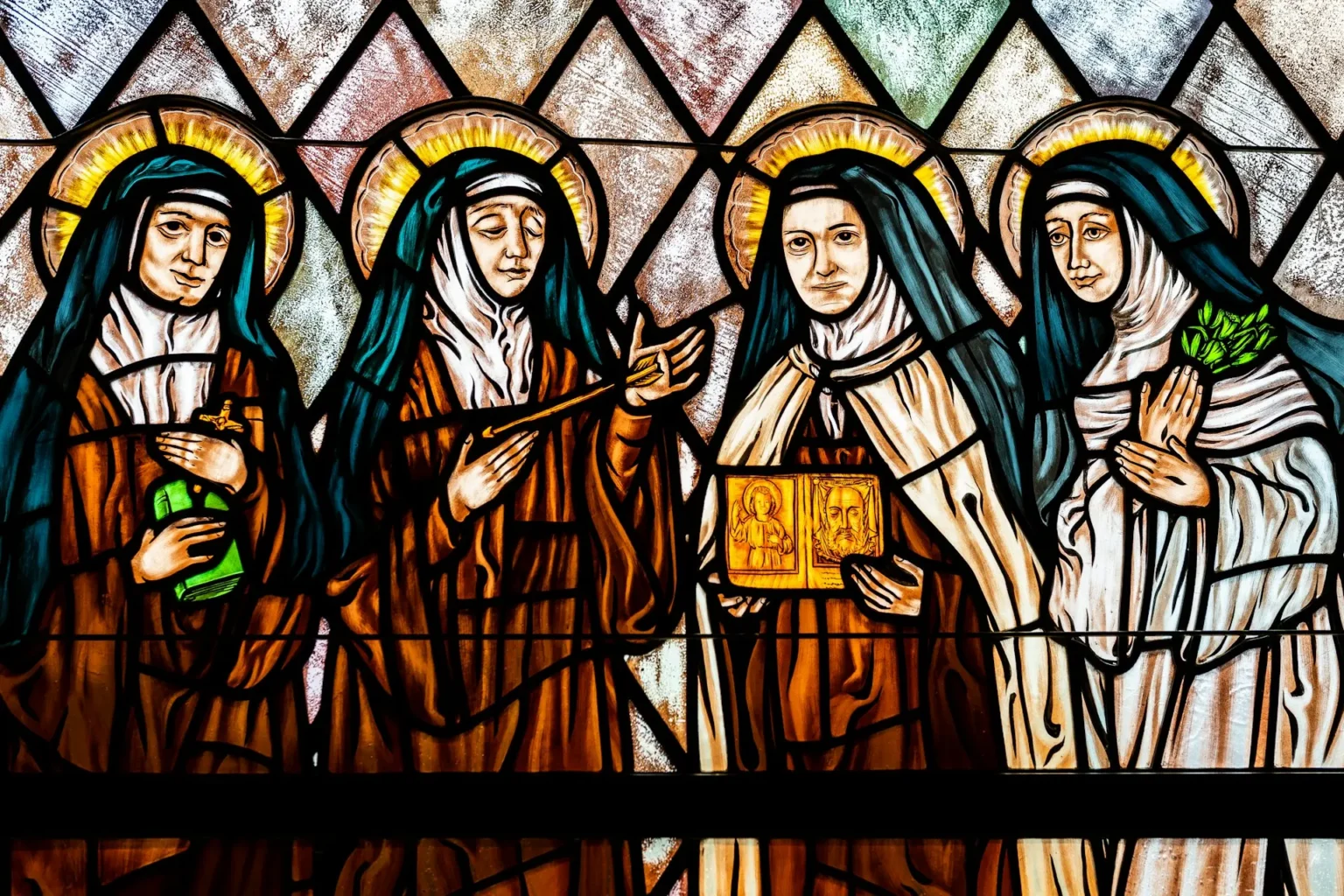
Today the Church is full of light. On the Solemnity of All Saints, our gaze is directed towards heaven – to where a countless multitude stands in white robes before God’s throne. This is a day when heaven and earth are closer to each other. This is a day when we remember those who have allowed God’s light to penetrate their lives, so that it became a light for the whole world. And if we look up right here, in our Church, we see this truth with our own eyes. Around us shine the stained-glass windows of saints – Teresa Benedicta of the Cross, Saint Dominic, Saint Casimir, Saints Methodius and Cyril, Saint Francis, and many others. Each of them is different: from a different era, nationality, with their own character and calling. But when light falls through these colored glass panes, they become one – a single image of the light of Christ.
When it is dim or night in the Church, the stained-glass windows appear dark and silent. Like now. But when light begins to pour in, a miracle happens – they come alive. Colors, lines, and faces awaken to life, and we perceive that their beauty comes not from the glass itself, but from the light that penetrates them. So it is with the saints. They were not perfect, but people who allowed the light – God’s grace and the Gospel – to penetrate their lives. This light gave meaning to both their joy and their suffering, their strength and their weakness.
Jesus proclaims the eight Beatitudes in the Sermon on the Mount – and when we read them, we notice something unexpected: those called blessed are not the strong and powerful, but those who mourn, who are merciful, pure in heart, peacemakers. Precisely where the world sees weakness, God sees holiness. Holiness is the courage to live love where it is not easy to do so. Sometimes we are tempted to think that holiness belongs only to monasteries and altars. But in reality, saints live beside us: a mother who forgives her child; a caregiver who manages to care; a young person who is not afraid to be a believer; an elderly person who prays quietly every day. They are those who allow God’s light to reflect in their lives.
It is written in the Letter of John: “See what great love the Father has lavished on us, that we should be called children of God! And that is what we are.” This means that holiness is not merely a privilege for a few, but a calling for everyone. Holiness is not a mountain peak that only a few can reach – it is a light that can shine in every heart if a person allows God to enter it.
Pope Benedict XVI has said: “Sometimes we think that holiness is a special status, reserved only for a few chosen ones. In reality, becoming holy is the task of every Christian – indeed, the calling of every person!” (Pope Benedict XVI, Angelus on the Solemnity of All Saints, 1 November 2007).
Stained glass is a good illustration of what it means to be holy: the glass itself does not emit light, but allows light to live within it. If light is absent, it remains empty; but when light comes, it becomes something beautiful and vibrant. Saints are people who did not hide God’s light, but allowed it to pass through their lives – even through wounds and brokenness. When we look at our Church’s stained glass windows and the faces of the saints, we can reflect: what do they teach us about holiness?
Saint Dominic was a preacher of the Gospel who desired truth to shine in the world. His life teaches that light needs the Word – God’s Word must penetrate the darkness like a sunbeam through glass.
Saint Francis was a man of love who saw God’s beauty in every creature. He teaches that light does not need wealth or power – an open heart that allows light to dance within it is enough.
Saints Methodius and Cyril brought the Gospel to Northern Europe. They made the light speak in the people’s own language so that God’s truth would not be distant. They teach that light must be shared – it does not belong to just one people.
Saint Casimir, the Polish-Lithuanian prince who chose the path of humility and purity, shows that youth can also be a bearer of light. His life was like a young, shining piece of glass in a celestial stained-glass window.
And Teresa Benedicta of the Cross, Edith Stein – philosopher, Jew, Carmelite, and martyr – is like a dark glass through which light becomes deeper. Her life shows that even in the shadow of suffering and death, light can shine brighter than ever before.
All these saints are different, yet they allow the light to shine. Looking at them, we realize that our own lives can also be a part of that same stained glass.
Saints were not born from great, holy moments, but from daily faithfulness. They allowed the light to come through their prayers, work, friendship, and service. We can do this too – at home, at work, in the parish, at school. Every time we choose goodness instead of evil, forgiveness instead of revenge, peace instead of anxiety, the light begins to move within us. And this light does not remain independent of us – it reflects, spreads, transforms others. A single piece of glass illuminates nothing, but together with others, it creates a whole that can make the entire Church warm and alive.
We believe in the communion of saints – communio sanctorum. This means that all who belong to Christ are connected to one another: in heaven, in purgatory, and on earth. This is not merely a figure of speech, but a reality – an invisible, yet true bond. When we pray here on earth, we do not do it alone. Those who are already in heaven pray with us – the saints and our beloved departed, who await seeing God face to face. And when we say at Mass: “Therefore, we praise Your glory together with the angels and saints and sing a hymn of praise to You all together,” it is not merely a poetic expression – it is reality. Heaven and earth unite in one song.
This communion also means mutual care and intercession. We can pray to the saints, and they pray for us. They are not passive observers in heaven, but living friends who help us remain on the path of light. When we are in difficulty, we can call upon them for help:
• “Saint Francis, help me to be joyful and peaceful.”
• “Saint Dominic, help me to remain faithful to the truth.”
• “Saint Teresa Benedicta, help me to see hope even in suffering.”
The Communion of Saints is a visible network of God’s love that extends beyond time and space. As we stand before the altar, there is an invisible multitude beside us – those whom God has already received, and those who are still on their way. That is why All Saints’ Day is a day of joy. It reminds us that faith is not a solitary path, but a journey with many friends – both living and departed.
For me, the Solemnity of All Saints is the happiest feast of the year. For saints are not just distant heroes or images in stained glass – they are living witnesses who show us how to believe, to long for God, and to live with Him already here and now.
May this feast be a reminder and encouragement to all of us: let us not be afraid to long to become a saint. God’s love calls us all, and every small step in faith, every good deed, and every prayer can lead us towards His light.
Let us go forward encouraged, knowing that saints are our examples and friends who inspire us to live in God’s love every day.