
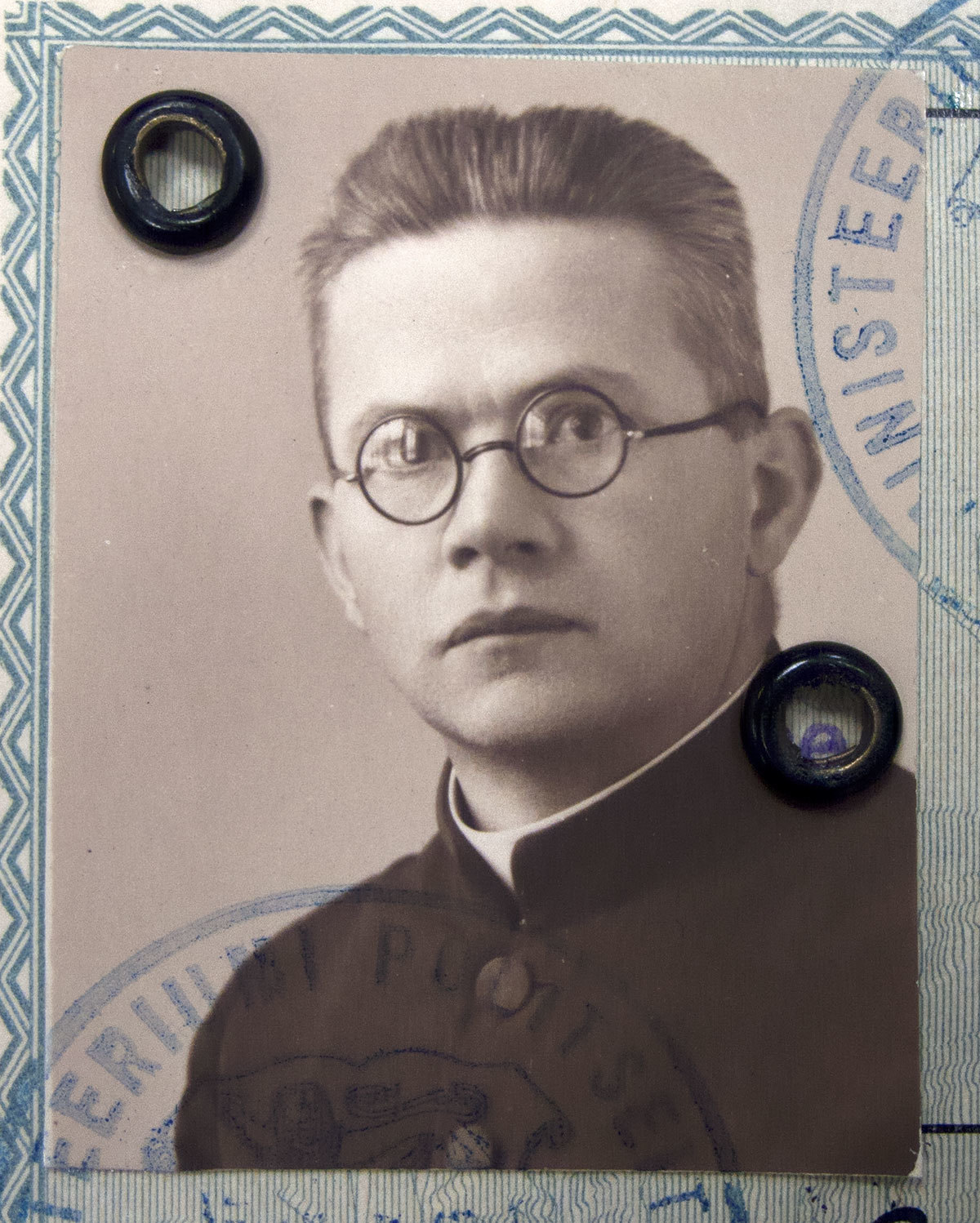
Remembering Archbishop Eduard Profittlich
Tomasz Materna, Parish Priest of Saints Peter and Paul Cathedral
October 22, 2023
Reading the texts from the book ‘Faith and Peace,’ we can discern Bishop Eduard Profittlich’s profound spirituality. It can be confidently stated that Bishop Profittlich can serve as a spiritual role model for all of us. His texts remain relevant even today. Although they were written over half a century ago, we can rediscover them even now.
For me, however, Bishop Profittlich is first and foremost an example for priests.
Therefore, in this lecture, I will focus on Archbishop Profittlich as a cleric,
who is a great example for priests.
1. The Grandeur of the Priestly Vocation
In Archbishop Profittlich’s consciousness, the conviction formed that there is no nobler
vocation than that of a priest. In it, a person achieves personal sanctification. He
saw the grandeur of the priestly vocation in the mystery of union with Christ. This
understanding was based on the essence and mission of sacramental priesthood, which
is realized in Christ. Thus, Profittlich was dedicated to living
as a priest following the example of Christ as Shepherd and Servant. This expressed his
conviction that priesthood is the greatest grace in and for the Church. He saw its
grandeur in the identity of the priest. He was convinced that the Sacrament of Priestly Ordination
is rooted in Christ. This was reflected in his own attitude. He wanted to be
what he became on August 27, 1922, when he was ordained a priest. He strived to become
a priest in the image of Christ, with his thoughts, service, and love. He desired
to give his life to Christ: “I would have wished to tell everyone how good
God is to us when we completely give ourselves to Him; how happy
we can become if we are ready to give everything – freedom and life – to Christ.”
Moreover, he was convinced that God counts the called among His closest friends.
This also formed the basis of his fervent care for shaping the quality of his spiritual life.
Understood in this way, the grandeur of the priesthood became evident in life
in holiness, which he compared to imitating the lifestyle of Jesus. This prompted him
to engage in shaping his own spirituality. His priestly identity determined for him
indeed the direction and goal of his spiritual formation. Therefore, there arose
to the forefront a sense of responsibility for the gift received, which was noticeable in all his
dimensions of priestly life and ministry.
He felt responsible for it, for its quality. This attitude bore fruit in his dedication to his work: „But
much has remained of what I have been allowed to do for the good of souls.
And precisely some converts received into the Church by me in recent years
show truly moving love and gratitude. Thus, despite everything, I cannot
adequately thank God for all that He has allowed me to do here
to do.“ We also find a similar mindset in Saint Pope John Paul II
as well. He taught that „being a priest is undoubtedly a great and magnificent
dignity: but it is also a great responsibility.“ This awareness should engender
a sense of responsibility for the quality of one’s own spirituality, so that it may mature in such a way that it
corresponds to the words of Saint Apostle Paul: I, who am a prisoner for Christ’s sake,
call upon you to live worthy of the calling with which you have been called. (Eph 4:1).
Bishop Profittlich knew that his power was the Holy Eucharist. He certainly
prayed much for the Most Holy Sacrament. He wrote: „If we could, as
we should and would want to – then every day should be such a Day of the Lord’s Body. For
without the Most Holy Sacrament, our Holy Church is inconceivable, not even for a single
day. Without this Sacrament, the Church would be without sacrifice, the tabernacle would be without a soul,
houses of God could close their doors; priests would no longer be priests.“
2. Care for the Evangelical Formation of the Lives of the Faithful
Archbishop Eduard Profittlich’s spiritual maturity bore fruit in his
care for the quality of spirituality of the faithful he served. He bore
concern for the realization of their holy vocation. He wrote: „Thus, when
an individual fulfills God’s commandments, things go well for him. If all
if family members fulfill God’s commandments, then that family will fare well. And
the same applies to the people, to the state.” As an eager and caring pastor, he believed that this
is possible to accomplish in the life of every Christian. The realization of this calling occurs
within the framework of a specific spiritual upbringing. This vision of pastoral ministry
characterized Archbishop Eduard Profittlich. His work was characterized by great zeal and
devotion. He wished for Estonia to become a Christian nation again. He wrote:
“Therefore, all nations, if they wish to continue to exist, must turn
back to the Christian way of life and Christian principles. And this also applies to the Estonian
people. If the Estonian people want to endure, then they must become again
completely Christian. And this applies not only to the common people, but to the entire nation.”
He emphasized the role of faith in human life. Subsequently, he focused on shaping faith and a Christian way of life
on. He expressed this with the words: “The Word of God, as it is contained
in Sacred Scripture and Sacred Tradition, the bishop must listen to it as the Word of God and
proclaim it to the faithful, according to the needs of the time. This is his serious duty and
responsibility. He must, according to the words of Saint Paul in his letter to the Hebrews,
watch over the souls of the faithful – “I therefore implore you to walk worthily of the vocation
to which you have been called.” (Eph 4:1) I wish to continue these admonitions
alongside the motto I have chosen for my episcopal activity: “Fides
et pax” – “Faith and peace.”
As bishop, he proclaimed the special role of marriage in society: “Fidelity, which is
inherent in every marriage, must become firm and unshakeable in Christian marriage,
due to the marital bond with Christ and the Church. Christ’s great faithfulness towards the Church
should be the example and reason for fidelity in Christian marriage!””
3. Formation of Supernatural Faith
The foundation of spiritual life is supernatural faith, which God grants in the Sacrament of Baptism.
Sacrament. As a gift from God, it serves as the basis for discerning one’s calling,
because it provides the ability to know and receive God’s will. “Our holy Catholic faith
– Archbishop Profittlich taught – firstly gives great certainty to our lives. Since
today, everywhere around us, there is so much unclarity and
confusion, a great clarity and certainty in matters of faith and life has been given to all of us.
The foundation of this certainty is Jesus Christ Himself, the eternal truth, who ‘for this purpose was
born and for this purpose came into the world, to bear witness to the truth’ (John 18:37). Therefore,
he paid attention to its formation, because this is how man’s encounter
with God takes place. He described it figuratively: ‘God is the sun in the heaven of our spirit,
expanse. And we have spiritual eyes, with which we can see and know God. And
therefore people of all ages believed in God, because they saw Him with their
spiritual eyes.’ Therefore, the fulfillment of the Christian vocation depends on the maturity of this faith.
The more it takes on the form of the Gospel, the more it awakens the desire
for spiritual communion and personal intimacy with Him. Such a vision was
the fruit of Bishop Profittlich’s spiritual life, the foundation of which was undoubtedly faith. Thus,
from this attitude arose an eager care for its formation in the lives of the baptized. Faith
thus shaped his personality. His teachings were in fact the words of the Gospel,
which he proclaimed with great dedication and conviction.
Since supernatural faith is born from hearing the Word of God, Bishop Profittlich proclaimed it zealously and dedicatedly.
It is no wonder that so many of his sermons and articles have been
preserved. His sermons and articles testify that the Word of God was
for him an important means of shaping the spiritual life of his flock. Through this, he aimed for
spiritual formation by proclaiming the Gospel and explaining it in such a way that it
found a response of faith in the listeners. He wrote: ‘Truly, a truly believing person sees
the world in a completely different light. His faith makes him clairvoyant and clearly
audient, so that he can see and hear things that another person does not see.’ He
accomplished this not only in his ministries, but in every situation. He used it
to deepen the Christian faith. He directed it towards the person of God Himself. Although he was
demanding, people liked him and he drew them to Christ. He had
undeniable moral authority, and his word carried weight. He was considered zealous and
an exemplary priest and bishop. With his credible priestly demeanor, he was
an example to others. Thus, Archbishop Eduard Profittlich’s pastoral work was characterized by
authentic spiritual formation, which is expressed in the attitudes of the faithful. For him,
faith was also connected with optimism: “Faith, and the knowledge of God’s work in the world,
gives the faithful person the assurance that for the good person, all things
work for good, that holy optimism that God’s undertaking, and with it also
his undertaking, will prevail. This is the victory that conquers the world, your faith.”
In his episcopal mission, he lived out his motto “Faith and Peace.” The word
peace appears repeatedly in his texts. “God is indeed the abode of peace. Unchanging,
the Eternal One is Himself in the deepest peace. He is also the source of all peace. Peace
radiates from Him already in creation. In Him we find an outpouring of peace. The boundless sea in its
silence, the mountain ridges in their solitude, the forest and meadows in the morning twilight
reflect much of this Eternal peace.”
In conclusion, it can be said that Archbishop Eduard Profittlich was and is a spiritual
example for priests, but also for all the faithful. He dedicated his life to Christ and
the Church, and this was expressed by his readiness to die as a martyr. Let this lecture conclude with
the last two sentences of this book and also the last words he
wrote: “But come what may, we are in God’s hands and He turns it all
for good. And all this will become a blessing for us when we reach God’s
kingdom.”