
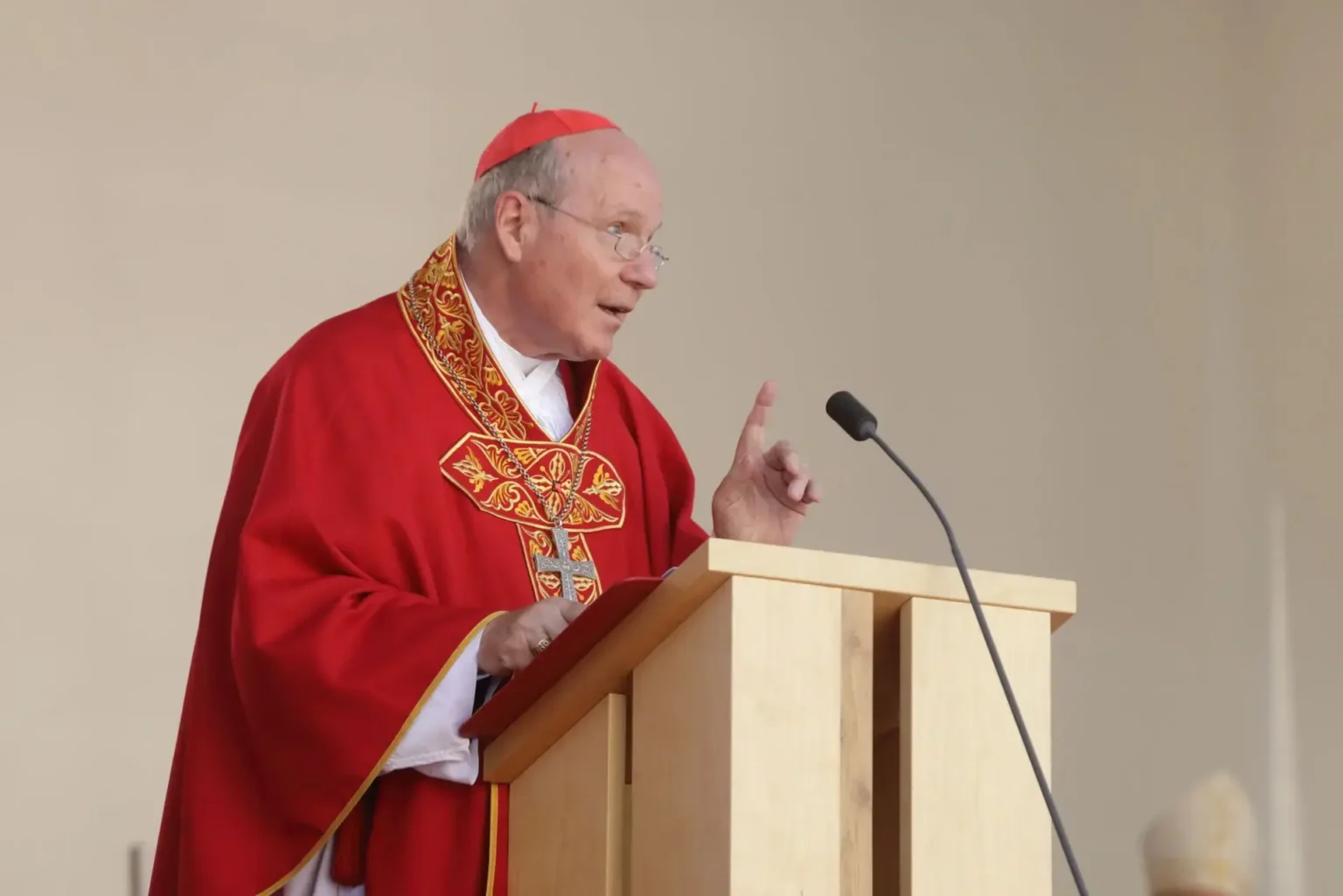
September 6, 2025
Book of Wisdom 3:1-9; Romans 8:31b-39; John 17:11b-19
The day before yesterday, on September 4th, during an almost 24-hour reading, names were simply mentioned: the names of victims, more than 23,000 names, all of whom died in Soviet prison camps or Siberia. Behind every name was a story, a face, a heart, a person. No one was nameless, anonymous, just a number, one of countless figures, before God. Thank you for the initiative of the Dominicans, my confreres! Thank you to all who participated in this reading. Above all, thanks be to God Himself, who has promised us that all these names are written by His hand. In the first reading, we heard: “But the souls of the righteous are in the hand of God, and no torment will ever touch them.” One name has been mentioned much recently, one among the 23,000: Archbishop Eduard Profittlich. Of course, none of the other victims will be forgotten, even if their names were mentioned only once during the long hours of reading all the names.
I remember a catechesis by Pope Benedict. It was the last catechesis in a series on saints. It was dedicated to the countless unknown saints whose names are written in God’s Book of Life, even if they have never been individually entered into the Church’s calendar of saints. This catechesis is unforgettable for me. Today, it particularly moves me. These unknown saints are the immediate and profound reason for Archbishop Profittlich’s beatification today. They, the faithful of his Diocese of Tallinn, are the reason why he is elevated to the glory of the altars today. Because he did not want to abandon them, he did not return to Germany, knowing full well that this would almost inevitably lead to his death.
In the early Church, for example in Paul’s letters, believers are called “saints.” For the sake of these saints, his flock, his sheep, Father Profittlich was ready to give up his life. He could have presented clever arguments to avoid this, for example, to help later as a survivor. The guidance he sought from Pope Pius XII did not come in the form of a command, but rather as advice: he should make his decision “first and foremost bearing in mind the well-being of the souls entrusted to his care.” After making his decision, he wrote to his family that “it is fitting for a shepherd to remain with his flock and share their joys and sorrows.” His honesty is very moving: “I must say that although making the decision took several weeks of preparation, I did not do it with fear or anxiety, but rather with great joy.” This joy shines through in the words of the Apostle Paul in today’s sermon from the letter to the Romans: “Who can separate us from the love of Christ?” With this joy of Christ, the archbishop was able to touch, comfort, and support his faithful souls and evidently many others as well.
Beatification is never directed only at one person. “He who believes is never alone!” said Pope Benedict. Archbishop Eduard’s decision was supported by the prayers of the faithful for their bishop. One day we will experience, see, and understand how many people’s prayers and faithful lives invisibly protected and guided our own path. Today’s beatification encompasses all those who shaped the path of Father P. Eduard, first and foremost his parents, of whose ten children he was the eighth, his teachers, friends (how important they are!) and the ecclesiastical places and people who shaped him. Who can ever measure what people, situations, and experiences have shaped and tested all of us! All this together enabled him to utter such a clear “yes” to possible martyrdom, like that of Archbishop Profittlich, at the decisive hour. This was his very personal “yes,” and yet it is something more: it is the Church’s “yes” to God’s will, expressed in the individual’s “yes.” Personal sanctity is always supported by the sanctity of the Church, the Bride of Christ. Therefore, today is a day of joy for the Church, especially for the Church in Estonia.
The names of 23,000 victims, including our present-day witness of faith, remind us that every human life was placed in the context of an extremely dramatic time. Today’s beatification cannot ignore what was happening in Europe and the world at that time. It was the unleashing of an unimaginable hellish force. Hitler in Germany, Stalin in the Soviet Union. The agreement between these two to share the spoils in what was undoubtedly the most insane war of all time. As soon as the spoils were divided, one robber attacked the other to seize everything for himself: “Today Germany belongs to us, and tomorrow the whole world.” Concentration camps and the Gulag were expressions of complete contempt for human dignity. What a contrast this formed with the dignity with which Archbishop Profittlich surrendered to the NKVD officials. His faith gave him peace and steadfastness. As one of millions of victims of two murderous ideologies, he died on February 22, 1942.
The beatification of Archbishop Eduard Profittlich is taking place at a time when old wounds threaten to reopen. Especially in this part of the world, this concern is particularly acute. War is once again a bitter reality in this region. Hopes for peace are being tested. This is not the only crisis in today’s world. Pope Francis has often spoken of how we are in a “third world war in pieces” (una terza guerra mondiale a pezzi). This world war also includes the persecution of Christians worldwide. Other religions also experience regional persecutions, aggressive religious policies, and nationalist abuse of religions. Yet, the persecution of Christians is numerically the most widespread reality.
In this situation, the testimony of the blessed martyr-bishop takes on special significance. In his homeland, Germany, a massive systematic persecution of Jews was already underway, which soon became a bitter reality throughout German-occupied Eastern Europe. The idea that National Socialism or Soviet Communism would spare Christians soon proved to be an illusion. All of this could be repeated in our time. That is why Archbishop Profittlich’s attitude is so valuable today. It shows a Christian’s path during persecution. Two words from Eduard Profittlich particularly touched me. They are full of comfort and joy that can only come from God Himself. After deciding not to return to Germany, he wrote: “I do this with the greatest willingness, in fact I can say, with great joy. Although I cannot in any way predict how my life will now proceed, what sacrifices still await me, I walk this path with great trust in God, being firmly convinced that if God walks with me, I am never alone. And I also have a firm hope that the sacrifice I make in this country for the interests of God’s kingdom will not be fruitless, in one way or another.”
Early Christians said: sanguis martyrium – semen christianorum! The blood of martyrs is the seed of Christianity. This hope, which Father Eduard Profittlich fulfilled, can fill all of us at a time that has seen so many new martyrs. I will only briefly mention Pope John Paul II’s great project for the Holy Year 2000. He wanted to compile a collection of 20th-century martyrs. An entire team of historians worked intensely on this. One of them told me that they abandoned the project after 20,000 short biographies. They were only at the beginning of the work; such is the great number of 20th-century martyrs. Only God knows all their names! Yes, we can hope that the countless martyrs of our time, the names of 23,000 victims in this country alone, as Bishop Eduard said of himself, “will not remain completely fruitless.” We ask this of God today with the same confidence that filled him then.
Recently, there has been much talk about martyrdom. What captivated Christians in the early days was their joy. In today’s Gospel, in a passage from Jesus’ prayer in the Upper Room, Jesus asks His Father for this great gift: “But now I am coming to you, and I speak these things in the world, SO THAT MY JOY MAY BE MADE COMPLETE IN THEM.” This prayer of Jesus was truly and fully fulfilled in the life of Father Eduard, Archbishop Profittlich: “When it finally became clear that I would stay, my joy was so great that I prayed the Te Deum out of joy and gratitude. In general, I felt God’s grace so deeply in my soul that I have probably rarely felt as happy in my life as on the evening after the decision, and I have never celebrated Holy Mass as devoutly as… on the day of the decision.”
We now celebrate Holy Mass, where Eduard Profittlich is mentioned for the first time in the Eucharistic Prayer. May he ask Christ, whom he faithfully followed, for Christ’s joy, His joy in abundance!
Amen.