
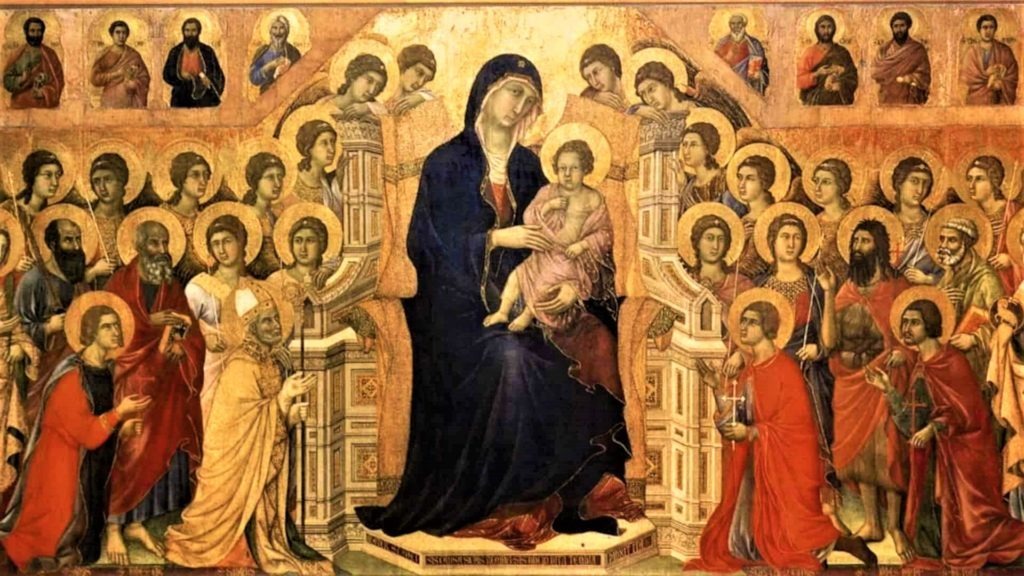
Saint Peter and Paul, Saint Barnabas, Saint Boniface, Saint Thomas Becket, Saint Mary Magdalene, Saint Athanasius, Saint Rose of Lima, Saint Casimir, pray for us.
Today we celebrate the Solemnity of All Saints, which is dedicated to those who have departed from this world and now rejoice with God in heaven. On this day, the Church presents to us a multitude of those who have reached the goal of life, who have fully fulfilled their lives. Today we remember all martyrs and confessors who sacrificed their lives for Christ. This feast is a celebration of life, because saints live with God in the heavenly Jerusalem. The Solemnity of All Saints invites us to reflect on who a saint is, in what ways people have excelled to become saints, how we can achieve holiness, and whether we can achieve it at all?
Nowadays, it is not easy to speak of saints. Moreover, the topic itself is not very attractive; it seems detached from life. Rather, we are accustomed to everything concerning earthly life. Secondly, holiness seems like something impossible. Me, a saint? That is impossible.
Who then is a saint? One can quote the catechism, theological works. However, a simple answer is given by the children of the Polish music group “Arka Noego” in their song “The Smiling Saint”:
“So big, so small, can become a saint.
So fat, so thin, can become a saint.
Someone like me and someone like you can become a saint”.
Anyone can be a saint: small, big, fat, thin, me and you. This song also gives the answer to the question of how to become a saint: “A saint loves God, is not afraid to sacrifice their life for others, loves their neighbor as themselves. Thus, we see that the condition for becoming a saint is love for God and neighbor. Holiness is the dedication of one’s life to God and to people; it is losing one’s life. Every Christian’s first vocation is precisely holiness. This vocation to holiness can be realized in different ways: in priesthood, in marriage, in religious life, or in solitude. Responding to the call, I must live in such a way as to achieve holiness, that is, to achieve salvation.
The recipe for achieving holiness is given by Christ in today’s Gospel. We see Jesus teaching the multitude and sharing the good news with them. In this multitude were poor people, sick people, people suffering from demons, people who were rejected. They came to listen to Jesus’ teaching to find comfort and understanding from Him. We see a contradiction in Jesus’ words. Christ says: “Blessed are the poor in spirit, blessed are those who mourn, blessed are the meek, blessed are those who are persecuted for righteousness’ sake.”
Blessed means happy; this is a literal translation from Greek. How then can the poor, the sorrowful, the persecuted be happy? But Christ looks a little further than our conception of a comfortable and carefree life on earth. He looks at what happens after our death. If we suffer here on earth, we will receive a reward in heaven. These words of Christ show that no hardship on earth is fruitless. Let us look around, how many people suffer, how many are persecuted. How many people hunger and thirst for righteousness, but there is no righteousness; how many tears, but no one can console them. And precisely such people came to Christ two thousand years ago, and He gave them hope that after death everything will be better, that God will not forget their sufferings and will grant them the reward of eternal life. “Rejoice and be glad, for your reward is great in heaven!”
The holiness that Jesus speaks of is not piety, nor an attempt to do extraordinary things, nor the search for one’s own perfection. However, saints are those who can live differently in such conditions: they can rejoice, be merciful, seek justice and peace. They are ready to do so even at great personal cost. However, the strength for such a way of life does not come from one’s own perfection, but from one’s relationship with Jesus. “Saints are precious pearls; they are always alive and relevant and never lose their significance. Their example illuminates the minds of people of our time, revitalizes faith, enlivens hope, and ignites love, so that everyone feels drawn to the beauty of the Gospel.”
Is holiness possible today, is following the eight Beatitudes realistic? I think most would answer no. However, we have many people who did not stand out for anything special, but simply loved God and their neighbor and became saints. “If we want to be perfect, we do not have to do anything more than fulfill our daily duties… Perfect is he who does his daily deeds correctly; to achieve perfection, we do not have to cross these boundaries.”
Achieving holiness is not a superhuman feat. It is enough to place our hope in God and keep our gaze on the ultimate goal, which is eternal life. It is worth adding that a saint is not a sad and gloomy person, but cheerful and happy. There is a proverb: “A sad saint is no saint.” But a saint is also a sinner who constantly repents, who fights against sin and asks God for forgiveness.
Let us not be afraid to strive for holiness, let us not be afraid to bear witness to Christ. Let us strive in our daily lives to bear witness to the love of God and man, through prayer, mutual help, goodness, and respect. Therefore, I wish for you and for myself that we may live our lives in such a way that after death we may sit before God’s throne in the heavenly Jerusalem with all the saints.
Father Tomasz Materna